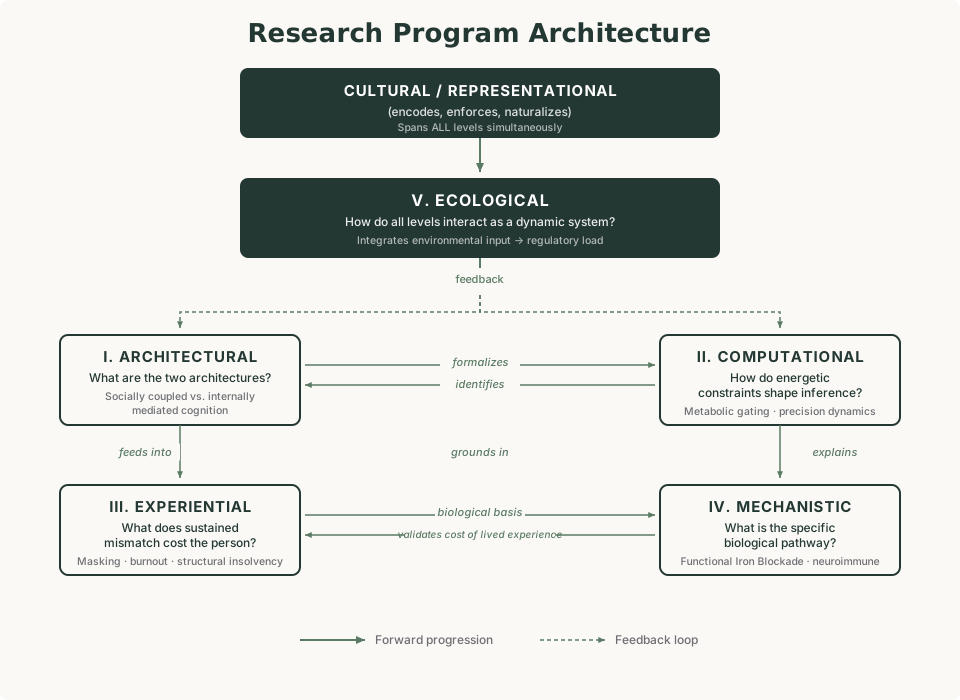
This research program develops an integrated account of How the brain organizes and manages cognitive processes — the underlying "operating system" that determines how we process social information, make predictions, and allocate mental energy., spanning Based on direct, first-person lived experience rather than external observation. In this research, autistic perspectives are treated as valid sources of knowledge about how different cognitive systems actually work. identification, computational formalization, metabolic mechanism, and ecological dynamics. The work operates across five interdependent levels of analysis, tracing the consequences of architectural mismatch within environments calibrated to a single norm. It also examines how these asymmetries are reproduced and stabilised within cultural and representational systems.
Identifies the regulatory architecture of majority social cognition as a specific system rather than an unexamined default. Examines how this architecture functions as the implicit normative baseline within psychological classification.
Working Paper: The Other Side of the Double Empathy Problem: Making Majority Social Cognition Visible as a Specific Regulatory Architecture
Status: Under Review. Preprint available on PsyArXiv (opens in a new tab).
The Core Conflict: For decades, psychology has treated one specific way of thinking as the "gold standard." If you don't think that way, you're labeled "disordered." This paper flips the script: "Normal" social thinking is just one cognitive style, not a universal truth.
Key Insights: The paper identifies two styles — Socially Coupled Cognition (the majority) and Internally Mediated Cognition (the autistic style). Data shows autistic-to-autistic pairs communicate just as effectively as non-autistic pairs. Diagnosis should be seen as "perspective-dependent," not a neutral description of a broken person.
The Recommendation: Stop trying to "fix" autistic cognition. Recognize both architectures as valid. We need environments calibrated for both styles, not just the most common one.
Formalizes the architectural distinction within A theory that the brain is constantly generating predictions about what will happen next, then updating those predictions based on sensory input. It's how we navigate the world without being overwhelmed by raw data. and The idea that we don't just passively predict the world — we act on it to make our predictions come true. When predictions and reality don't match, we either update our predictions or change the world to fit them. frameworks. Introduces How the brain decides which predictions to trust more. Some sensory signals get "turned up" (high precision) while others get "turned down." This process is metabolically expensive and differs between cognitive architectures. as metabolically constrained and develops the concept of When two people with different cognitive architectures interact, one person usually does more of the adjusting work. This creates an energy imbalance — one person's brain works harder to maintain the interaction..
Working Paper: Metabolic Gating in Social Interaction: An Energetic Account of Asymmetric Adaptation
Status: Under Review. Preprint available on Zenodo (opens in a new tab).
Why One Person Does All the Work: Ever notice how one person often carries the "weight" of a conversation? We usually blame personality or lack of interest, but this paper argues the cause is energetic, not psychological.
The Science of "Social Fatigue": Social attunement is expensive. The brain accounts for only 2% of body mass but consumes 20% of its energy. When one person's "energy budget" for social sensitivity runs out, they unconsciously disengage. The partner is then forced to absorb 100% of the coordination effort. This happens even when both people are highly motivated to connect — it's a hardware limitation, not a character flaw.
Impact for Autistic Adults: This framework validates "social burnout" as a physiological reality. Disengagement is often a survival tactic to preserve metabolic resources, not a lack of empathy.
Examines the lived experience of sustained regulatory load. Links energetic cost to How different aspects of identity — like being autistic, Black, queer, or disabled — combine to create unique experiences. The cost of navigating a non-autistic world is higher when you're also dealing with racism, sexism, or other forms of discrimination. identity, examining how chronic The extra mental and physical effort required to function in environments not designed for your brain. This includes masking (hiding autistic traits), forcing eye contact, suppressing stims, and constantly translating social cues that aren't intuitive. compounds across racialized, gendered, and neurological axes of normative categorization.
Working Paper: Structural Insolvency: Metabolic Sovereignty and the Bio-Political Economy of Autistic Burnout
Status: Under Review.
Burnout is a Hardware Crash: Clinical circles often treat autistic burnout like depression. This paper argues that's a dangerous mistake. Burnout is a metabolic bankruptcy — it occurs when a high-cost system (the autistic brain) is forced to spend more energy than it can possibly recover.
The "Tax" of Existing: Maintaining a "performed self" alongside an "authentic self" creates a massive energy debt. The "weathering" of autistic bodies leads to accelerated physical decline. Studies show autistic individuals face significantly higher rates of chronic health conditions and a lower life expectancy due to systemic stress.
The Path Forward: The author calls for Metabolic Justice — validating opacity (the right to not perform for others), auditing systemic energy debt, and recognizing monotropism as an essential energy-conservation strategy rather than a pathological fixation.
Proposes a specific The connection between the brain, immune system, and metabolism. Chronic stress from compensatory regulation doesn't just affect the mind — it triggers immune responses and disrupts how cells produce energy. pathway linking chronic compensatory regulation to Mitochondria are the "power plants" inside your cells that produce energy. When they don't work properly, you experience profound fatigue, brain fog, and physical exhaustion — symptoms commonly reported in autistic burnout.. Provides falsifiable biomarker predictions and a proposed study design.
Working Paper: Neuroimmune Metabolic Collapse in Autistic Burnout
Status: In preparation.
When your brain works harder just to function in everyday situations, your body pays the price. This research looks at the physical health effects of that extra effort — how constant stress from masking and compensating can lead to real, measurable damage to your immune system and energy production at the cellular level.
Traces how institutional environments generate chronic distress through structural incompatibility, constrained exit, and concealment-mediated feedback. Integrates all preceding levels into a transcultural analytic.
Working Paper: Rethinking the Category Fallacy: Environmental-Relational Trauma and the Institutional Production of Distress
Status: Submitted for publication.
When individuals struggle in schools, workplaces, or healthcare settings, distress is frequently generated by the structural design of the environment itself. Institutional environments are designed for normative ways of functioning, forcing those outside these norms to continuously suppress their natural responses—a highly effortful process called adaptive concealment. Over time, this produces cumulative harm: stress systems dysregulate, the body remains hyperaroused, and functioning deteriorates. ERT shifts focus from correcting individual pathology to redesigning incompatible environments.
Examines how cognitive regulatory architectures are encoded, enforced, and naturalized within narrative and media systems. Treats cultural forms as ecological environments that structure the distribution of interpretive authority, shaping whose cognition is legible, credible, and governable.
Status: In preparation.
Movies, TV shows, and books shape how society thinks about autism. This research looks at how media either helps or harms autistic people by the stories it tells. When TV shows portray autistic characters, who gets to decide what those characters are like? Often, the stories are filtered through non-autistic perspectives, which can distort how autistic people are understood.
These lines of inquiry are structurally interdependent.
Each level informs and is informed by the others.